Introduction
Imagine solving humanity’s most complex puzzles—from discovering new medicines to optimizing global networks—not in years, but in days. This is the definitive promise of the quantum data center. By 2026, the first commercially viable hybrid quantum-classical facilities will transition from advanced prototypes to operational powerhouses, marking a historic leap in computational capability.
This article provides a detailed blueprint for the architecture, security, and transformative applications of a 2026 quantum data center, translating cutting-edge theory into tangible business impact. Drawing from experience in high-performance computing infrastructure, this timeline aligns with the aggressive roadmaps of industry leaders like IBM and Quantinuum, who are already piloting these hybrid systems.
The Hybrid Architecture: Quantum Meets Classical
The 2026 quantum data center is a masterpiece of integration, not replacement. Its core philosophy is symbiosis: pairing exotic Quantum Processing Units (QPUs) with ultra-powerful classical supercomputers. This hybrid model, endorsed by the National Institute of Standards and Technology (NIST), ensures every task is routed to the most efficient processor.
Think of it as a precision pit crew. The classical system manages data and analyzes results, while the QPU executes the high-speed, specialized calculations that deliver the winning advantage.
The Quantum Processing Unit (QPU) Core
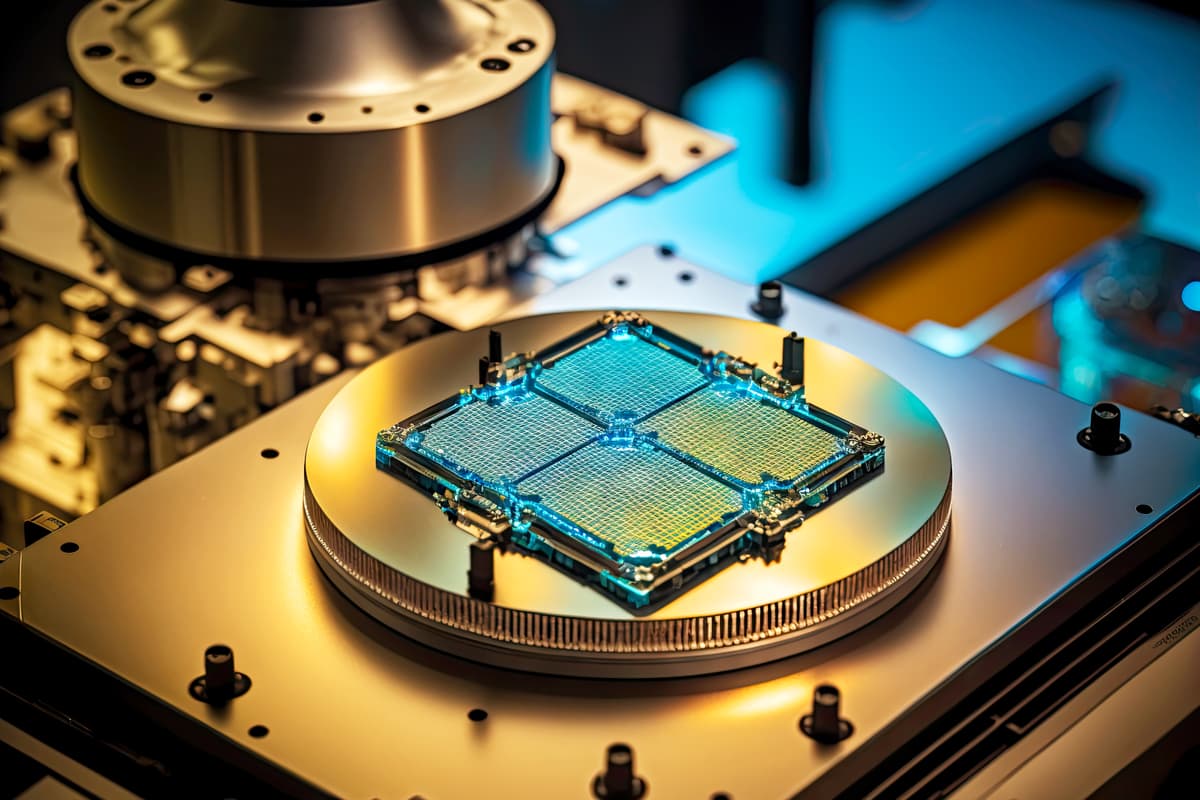
Step into the heart of the facility: the QPU core. This is not a standard server room. It is a laboratory-grade clean space housing quantum processors in isolated, shielded chambers. To maintain the fragile state of quantum coherence, these QPUs—using technologies like superconducting qubits or trapped ions—operate at a staggering 10 millikelvin, colder than deep space.
Access is hyper-restricted. The QPUs function as exquisite accelerators for specific, classically impossible algorithms. Their performance is measured by metrics like quantum volume, a benchmark of computational power and error rates that continues to double annually, as tracked by leading research institutions like IBM Quantum.
The Classical Orchestration Layer
Surrounding the QPU core is a state-of-the-art classical data center. This layer is the indispensable brain and workhorse of the entire operation. It performs four critical, interconnected roles:
- Data Management: Handling the massive, complex datasets required by quantum algorithms.
- Pre/Post-Processing: Preparing problems for the QPU and interpreting the probabilistic quantum results.
- Intelligent Orchestration: Using advanced middleware to dynamically split workloads between classical and quantum processors.
- Legacy Workloads: Seamlessly running conventional enterprise applications alongside quantum tasks.
Revolutionary Applications in Action
By 2026, quantum computing will graduate from experimentation to delivering tangible “quantum advantage” for specific, high-value problems. This NISQ-era (Noisy Intermediate-Scale Quantum) will generate real-world impact in key industries.
Advanced Material Science and Drug Discovery
The pharmaceutical and energy sectors will be fundamentally transformed. Quantum computers excel at simulating molecular and atomic interactions. In 2026, QPUs will model protein folding for novel drug candidates and the electronic structures of next-generation battery materials with unprecedented accuracy.
Here’s the practical workflow: A researcher submits a molecular simulation. The classical system prepares a tailored quantum circuit. The QPU executes this simulation thousands of times to build a statistical result. Finally, the classical system analyzes this data, enabling the virtual screening of millions of compounds in weeks instead of decades. This acceleration creates clear passive income potential through faster patent generation and decisive first-to-market advantages, a process detailed in reports on quantum computing’s commercial applications.
Optimizing Global Logistics and Finance
For finance and logistics, quantum optimization translates directly into profit. Algorithms can solve “combinatorial explosion” problems—like finding the most efficient global shipping route from billions of possibilities—far more efficiently than any classical computer.
Consider a global retailer: A quantum optimizer could dynamically reroute entire fleets in real-time based on weather, port delays, and fuel costs, potentially saving 15-20% in annual logistics expenses—a multi-billion dollar impact for large firms.
Financial institutions will deploy quantum-powered simulations for superior risk analysis and complex pricing models. The passive income potential here is rooted in unprecedented operational efficiency and identifying new arbitrage opportunities.
Unprecedented Security Protocols
Quantum computing presents a dual-edged sword for security: it threatens current encryption but also enables fundamentally unhackable new methods. A 2026 data center must be a fortress on both fronts.
Quantum Key Distribution (QKD) Networks
A defining feature will be its internal Quantum Key Distribution (QKD) network. QKD uses quantum particles (photons) to generate encryption keys. Any eavesdropping attempt inevitably disturbs the particles, revealing the intrusion instantly—a guarantee based on the laws of quantum mechanics.
This capability will also be offered as a premium “QKD-as-a-Service” to clients. Imagine a bank transmitting high-value settlement instructions or a company sharing core intellectual property with absolute, provable privacy. While practical QKD has range limits, 2026 designs will use trusted node networks to extend this secure web.
Post-Quantum Cryptography (PQC) Implementation
Protecting stored data requires a new encryption standard. The 2026 facility will be a pioneer in deploying Post-Quantum Cryptography (PQC)—new algorithms (like lattice-based cryptography) designed to resist attacks from both classical and future quantum computers.
The entire software stack will comply with the final standards from NIST’s PQC project, which provides critical guidance on post-quantum cryptographic algorithms. The Security Operations Center (SOC) will evolve into a Quantum-SOC, staffed by experts trained in both cyber-defense and quantum information theory to ensure comprehensive, next-generation protection.
The Physical and Environmental Design
Housing this technology requires re-engineering the traditional data center from the ground up, balancing extreme technical specifications with ambitious sustainability goals.
Specialized Cooling and Power Infrastructure
The power and cooling profile is unique. While the QPU’s cryogenic systems are energy-intensive, the “computational work per watt” for specific problems is revolutionary. The facility will use a multi-tiered approach: liquid cooling for classical servers and complex cryogenics for QPUs.
Power stability is existential. Beyond standard backups, facilities may employ advanced battery storage or strategic location near stable power sources to prevent unplanned “qubit warming.” A single thermal cycle can take a QPU offline for days, representing a significant loss in computational capacity and potential passive income.
Modular and Scalable Construction
With quantum hardware evolving rapidly, inflexibility is a fatal flaw. The 2026 data center will be built with modularity as a core principle. The QPU core will feature standardized interfaces for “plug-and-play” processor upgrades.
Classical compute will be housed in scalable, pod-based modules. This design enables a cost-effective “pay-as-you-grow” model, protecting capital investment and allowing the center to seamlessly integrate next-generation breakthroughs, thereby future-proofing its operational and revenue model.
A Step-by-Step Guide to Accessing Quantum Compute
For a business user in 2026, accessing quantum power will be as streamlined as using a cloud service today, abstracting the underlying complexity.
- Problem Assessment & API Integration: Your team uses a familiar cloud portal with specialized SDKs. The first, crucial step is a feasibility check to determine if your problem is quantum-ready, ensuring efficient resource use.
- Hybrid Workflow Submission: You submit the job. The platform’s intelligent compiler automatically dissects the problem, deciding which parts go to the QPU and which are handled by classical CPUs.
- Queueing and Execution: The quantum task enters a managed queue. The QPU runs the circuit thousands of times (“shots”) to account for quantum noise, building a probabilistic answer. Advanced schedulers maximize QPU utilization for profitability.
- Result Synthesis and Delivery: Raw quantum data flows back to the classical layer. Error correction algorithms refine the results, which are combined with classical computation and delivered as a actionable business insight directly to your dashboard.
FAQs
The core difference lies in the processing hardware and the type of problems solved. A traditional data center uses classical CPUs/GPUs for deterministic calculations. A quantum data center integrates Quantum Processing Units (QPUs) that leverage quantum mechanics (superposition, entanglement) to perform probabilistic calculations on specific, complex problems—like molecular simulation or global optimization—that are intractable for classical systems. It’s a hybrid facility where QPUs act as specialized accelerators within a classical infrastructure.
Businesses can leverage quantum computing for passive income in several ways: 1) Accelerated R&D: Dramatically faster drug discovery or material science leads to quicker patent acquisition and licensing revenue. 2) Operational Alpha: Quantum-optimized logistics, supply chains, and financial portfolios create continuous efficiency savings and new arbitrage opportunities. 3) Service Offering: Companies can offer Quantum-as-a-Service (QaaS) or specialized Quantum Key Distribution (QKD) security services, creating recurring revenue streams from clients accessing this cutting-edge capability.
Current widely-used encryption standards (like RSA) are vulnerable to being broken by sufficiently powerful future quantum computers using Shor’s algorithm. This is why the 2026 quantum data center blueprint emphasizes Post-Quantum Cryptography (PQC). Businesses should start planning now by conducting a “crypto-agility” audit, identifying critical data that needs long-term protection, and preparing to migrate to NIST-standardized PQC algorithms to future-proof their security before quantum threats become a reality.
Timeframe Expected Milestone Primary Industry Impact Passive Income Driver 2024-2026 (NISQ Era) Commercial hybrid quantum-classical data centers operational; quantum advantage for niche, high-value problems. Pharma (molecular modeling), Finance (portfolio optimization), Logistics (route planning). Faster time-to-market for patents, operational efficiency savings, premium QaaS fees. 2027-2030 Error-corrected logical qubits; broader range of commercially viable algorithms. Advanced Chemistry, AI/ML acceleration, Full-scale cryptographic transition. Licensing of quantum-discovered compounds/materials, superior predictive analytics services. 2030+ (Fault-Tolerant Era) Large-scale, general-purpose quantum computing accessible via cloud. Revolutionary discoveries across all scientific and engineering fields. Dominant market position for early adopters, intellectual property monopolies on breakthrough technologies.
“The 2026 quantum data center is not just a new type of server farm; it’s the foundational infrastructure for the next technological economy. Its hybrid nature ensures it delivers value today while being the scaffold upon which future, more powerful quantum systems will be built.” – Industry Analyst on Computational Evolution.
Conclusion
The 2026 quantum data center is the launchpad for a new era of computational economics. It is a hybrid engine of immense power, designed to solve specific, world-changing problems that are currently intractable. It will not replace classical computing but will augment it, creating powerful new streams of passive income through accelerated discovery, hyper-efficiency, and novel security services.
For forward-thinking organizations, the time to build quantum literacy, forge strategic partnerships, and future-proof encryption is now. The race for quantum advantage is underway, and the finish line is a facility where information obeys the profound laws of quantum mechanics. The journey begins with a single, hybrid computation, and 2026 is where that journey becomes a commercial reality.