
Introduction
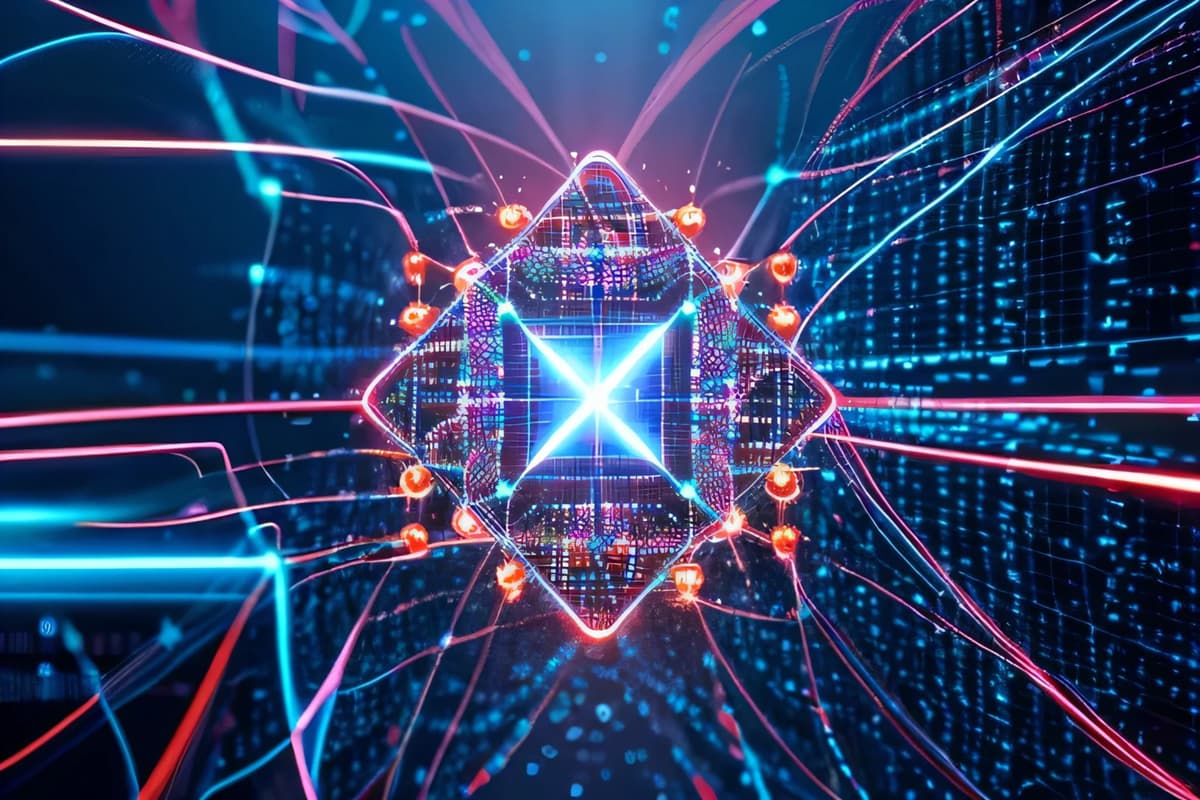
For centuries, art has given form to the invisible. Today, one of the most profound frontiers shaping our reality is the quantum realm. A dynamic movement is emerging where the mathematical frameworks of quantum physics directly inspire artistic practice. This work transforms complex ideas into public conversation.
This article explores the captivating aesthetics of quantum theory. We will examine how contemporary artists translate principles like superposition and entanglement into compelling sensory experiences. Our exploration is grounded in established physics, ensuring intellectual trustworthiness while celebrating creative innovation.
The Quantum Palette: Core Concepts Inspiring Artists
To appreciate quantum art, one must first grasp the scientific concepts that serve as both muse and medium. These ideas form a new visual and philosophical language. Their thoughtful representation is crucial for meaningful art-science collaboration.
Superposition and Probability Waves
The principle of superposition states that a quantum system, like an electron, can exist in multiple states at once until measured. This is visualized as a probability wave—a map of potential outcomes. For artists, this inspires explorations of ambiguity, challenging our classical “either/or” logic. The foundational nature of this concept is well-documented by authoritative scientific bodies like the American Physical Society.
Quantum art trains our perception to embrace probability, ambiguity, and multiple simultaneous truths.
Consider a digital artwork that changes form based on a viewer’s presence, embodying the “collapse” of the wave function. The aesthetic is one of fluidity and participatory reality. Crucially, artistic “superposition” is a metaphor; true quantum effects are subatomic. This distinction maintains scientific integrity while allowing profound creative interpretation.
Quantum Entanglement and Non-Locality
Quantum entanglement describes a powerful connection where linked particles influence each other instantly, regardless of distance. This “spooky action at a distance” inspires an aesthetic of profound, invisible connection.
Artists create works that are physically separate but behave as a unified system. For instance, two sound installations on different continents might harmonize in real-time, modeling an entangled state. These implementations poignantly metaphorize the interconnectedness central to quantum theory, a phenomenon whose experimental verification was recognized with the 2022 Nobel Prize in Physics.
Mediums of the Quantum: From Canvas to Code
Interpreting quantum ideas requires tools capable of embodying their dynamic, probabilistic nature. Artists are leveraging new technologies, often through direct partnerships with scientific institutions.
Generative and Algorithmic Art
Generative art, where an artist-defined system creates outcomes, is a natural fit. The algorithm acts as a wave function, defining a space of possibilities. Each unique execution represents a “collapsed” state.
Some artists integrate quantum random number generators (QRNGs). These devices harness intrinsic quantum noise, like photon detection. Using a QRNG ties the artwork’s genesis to a genuine quantum process, modeling the fundamental unpredictability of the quantum world. The technology behind such true random number generation is an active area of research in quantum information science.
Method Source of Randomness Connection to Quantum Concept Traditional Algorithmic Art Pseudo-Random Number Generator (Software) Metaphorical; models probability conceptually Quantum-Inspired Generative Art Quantum Random Number Generator (Hardware) Direct; uses genuine quantum phenomena as input Interactive Installation Viewer Input & Environmental Sensors Models the “observer effect” and collapse
Interactive and Immersive Installations
To make the observer’s role explicit, artists build immersive environments. These create a direct feedback loop between the participant and the piece. Using sensors, the artwork evolves in real-time, making the viewer a co-creator.
The goal is to induce a phenomenological understanding of concepts like the observer effect. This requires meticulous technical calibration to ensure interactivity feels intentional. Adhering to best practices in experiential design enhances the work’s professionalism and emotional impact.
Major Artists and Pioneering Works
A dedicated community of artists, often working alongside physicists, is establishing the canon of quantum-inspired art. Their work provides credible and compelling case studies.
Julian Voss-Andreae and the Sculpture of Wave-Particle Duality
Sculptor Julian Voss-Andreae, who holds a degree in quantum physics, creates stunning materializations of quantum principles. His “Quantum Man” series is constructed from thin, parallel steel sheets. From one angle, a solid figure emerges; from the side, it nearly vanishes.
This work directly references the famous double-slit experiment, making wave-particle duality tangible. Voss-Andreae’s authority is cemented by peer-reviewed publications, which detail the scientific rigor behind his artistic vision. It is a perfect synthesis of disciplines.
TeamLab and Immersive Quantum Ecosystems
The Japanese art collective TeamLab creates vast, immersive digital environments. These model quantum-inspired interconnectedness. In installations like “Borderless,” elements evolve through continuous, non-linear calculation.
This growing movement builds bridges of light, sound, and space. It transforms probability into pattern and entanglement into empathy.
Their work creates a powerful metaphor for an entangled ecosystem, where every element affects the whole. It applies principles of non-locality on a human scale. TeamLab’s global exhibitions and proprietary technology establish their authority in creating awe-inspiring, participatory worlds.
The Philosophical Implications: Art as a Tool for Understanding
Beyond visual spectacle, quantum art engages in deep philosophical inquiry. It serves as a vital tool for public engagement with science’s biggest questions.
Challenging Classical Perception
Traditional art often reinforces a deterministic, Newtonian worldview. Quantum art actively subverts this. It trains our perception to embrace probability, ambiguity, and multiple simultaneous truths.
The aesthetic experience becomes a form of cognitive training. A balanced perspective acknowledges that art simplifies; it is a gateway to curiosity, not a replacement for mathematical rigor. This honest framing builds trust and positions art as a complementary partner to science education.
Bridging the Two Cultures
Quantum art directly addresses the historic divide between the sciences and the humanities. It demands artistic engagement with scientific rigor and invites scientists to appreciate the power of metaphor.
Authoritative residency programs like Art@CMS at CERN or the MIT Center for Art, Science & Technology are fertile grounds for collaboration. The resulting exhibitions create a shared cultural language, making abstract science accessible and emotionally resonant for all.
How to Engage with Quantum Art: A Viewer’s Guide
Approaching quantum-inspired art can be uniquely rewarding. Use this actionable guide to deepen your appreciation and critical engagement.
- Suspend Classical Expectations: Let go of the need for a single, fixed interpretation. Move around the artwork. Engage with it from different angles to experience its multiple “states.”
- Investigate the Interaction: Is the artwork static or responsive? If interactive, determine how your presence changes it. Look for explanatory panels on the methodology.
- Seek the System, Not Just the Output: In generative works, look for the underlying rules. The beauty lies in the emergent order from a defined set of procedures—a core quantum concept.
- Analyze the Metaphor: Ask yourself: “What quantum idea is being referenced?” A strong work will have a coherent conceptual link without making unfounded claims.
- Embrace a Two-Stage Response: First, allow yourself to feel the emotions or sensations. Then, inquire. Read the artist’s statement. The most powerful work marries intuitive resonance with intellectual curiosity.
FAQs
Not always. While some artists use tools like Quantum Random Number Generators (QRNGs) or collaborate with labs, much quantum art is inspired by the concepts of quantum theory. The primary goal is often to create a metaphor or sensory experience that conveys ideas like superposition or entanglement, rather than to directly manipulate quantum systems. The artistic approach can range from purely conceptual to technologically integrated.
No, a deep scientific understanding is not required. In fact, a key purpose of this art is to provide an intuitive, emotional gateway into these complex ideas. You can engage with the work on a sensory level first—observing its behavior, forms, and your own reaction. The art often serves as the starting point for curiosity, prompting you to learn more about the science behind the inspiration.
The key difference is intentionality and grounding. Quantum art is specifically inspired by and seeks to interpret the established principles of quantum mechanics (even if metaphorically). It often involves research or collaboration with scientists. Sci-fi art may imagine future technologies loosely based on science, while pure abstract art may not reference an external conceptual framework. Quantum art sits at a deliberate intersection of disciplined scientific inquiry and creative expression.
Conclusion
The aesthetics of quantum theory marks a thrilling evolution in artistic expression and public science communication. By transmuting mathematical principles into visceral experiences, artists provide new perceptual tools to comprehend the universe’s fundamental nature.
This growing movement builds bridges of light, sound, and space. It transforms probability into pattern and entanglement into empathy. Rooted in credible collaboration, it does more than decorate ideas—it challenges the very frameworks through which we construct reality. As you encounter such art, lean into those shimmering moments of possibility. You are not just a viewer but a participant in one of the most vital dialogues of our time.