
Introduction
Cyberpunk is more than a genre; it’s a visual and philosophical language for our modern anxieties. It speaks directly to our tangled relationship with technology, societal control, and our own humanity. Imagine a world where rain-slicked neon reflects off corporate monoliths, and street-level hackers blur the line between flesh and circuitry.
Born from authors like William Gibson, this aesthetic has become a dominant force shaping film, fashion, and design. As a concept artist, I’ve guided teams to translate these core principles from page to screen. This guide will unpack 20 essential cyberpunk aesthetics, giving you a clear map to navigate its sprawling, evocative landscape.
The Foundational Pillars
Before exploring specific styles, we must understand the core principles that define every true cyberpunk world. These non-negotiable elements create its unique atmosphere and tension.
High Tech, Low Life
This is the central, defining paradox. It portrays a world where staggering technological wonders exist alongside profound human suffering. Think of flying cars soaring over polluted slums, or a beggar with a sophisticated prosthetic arm. This contrast, central to William Gibson’s Neuromancer, highlights the unequal distribution of progress and is a key theme in discussions of technology and social inequality.
The aesthetic is a study in deliberate juxtaposition. A pristine holographic ad flickers above a grimy alley littered with analog trash. In practice, designers build this by layering: we model the decay and “low-life” elements first, then strategically place “high-tech” items to create maximum visual and thematic conflict. This approach ensures the world feels inherently unequal and tense.
Neon-Noir Atmosphere
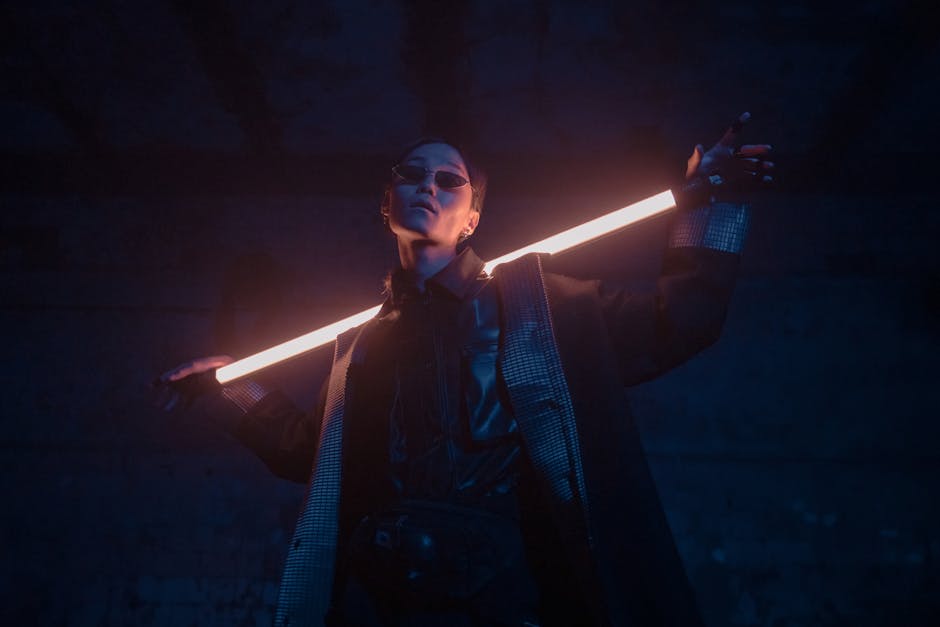
Cyberpunk visuals borrow the soul of 1940s film noir and digitize it. The palette drowns in inky blacks and deep blues, shattered by vibrant neon signs in electric pink and cyan. Light is almost never natural; it’s artificial, bleeding from signs and screens—a technique mastered in Blade Runner.
This creates a world of perpetual night or rainy twilight. The rain is functional; it reflects the neon, turning streets into shimmering rivers of color and amplifying the feeling of a dense, claustrophobic city. It’s the perfect setting for stories of outcasts and detectives. Technically, this relies on volumetric fog and screen-space reflections to make light feel tangible in the polluted air.
Urban Environment & Architecture
The city is not just a setting; it’s the central, oppressive character. It’s an active entity that shapes every life within it, a concrete manifestation of social divides.
The Vertical City & Megastructures
Cyberpunk cities explode upward. As ground level becomes uninhabitable, society builds in layers. Consider the endless tiers of Blade Runner‘s LA or the orbital plates of Night City. Architecture mixes brutalist foundations with sleek corporate spires.
This leads to megastructures—self-contained arcologies for the elite. These fortress-cities, inspired by architects like Zaha Hadid, offer clean air and safety, looming over the sprawl like castles. Effective world-building establishes a clear visual hierarchy: the deeper you descend, the older, more crowded, and more neglected the environment becomes.
Sprawl, Clutter & Retro-Fitting
In stark contrast to the sleek megastructures, most of the city is a chaotic, dense sprawl. Streets are crammed with multi-lingual signs, tangled cables, and makeshift stalls. Technology isn’t integrated cleanly; it’s bolted onto the old.
This “circuitpunk” or “grunge tech” aesthetic shows satellite dishes on brick walls and holograms powered by jury-rigged generators. It creates a world that feels lived-in and perpetually under repair.
A key technique from environment design is the “rule of three”: for every clean wall or structure, add at least three layers of clutter—like pipes, graffiti, or ads—to break up silhouettes and imply history.
Technology & The Human Interface
Cyberpunk is fundamentally concerned with how technology invades and alters the human body and mind. This is where the “punk” spirit often rebels against dehumanizing systems.
Cybernetic Enhancement & Biotech
The fusion of human and machine is a cornerstone. This isn’t about invisible implants; it’s about visible cybernetics. Think robotic limbs with exposed pistons, subdermal LED lighting, or optical implants with a mechanical iris. The style ranges from corporate chrome to street-level modifications held together with scrap metal, as seen in Battle Angel Alita.
Alongside mechanics, biotech introduces body-horror elements: vat-grown organs and genetic tailoring. The visual tension constantly asks, “What remains human?” Design here must consider origin and wear: a corporate limb is pristine, while a street model shows weld marks, mismatched plating, and grime.
Glitch, Hacking & Digital Fragmentation
The digital realm in cyberpunk is not smooth or safe. It’s fragmented and glitchy. Hacking interfaces might visualize data as cascading code or neon-lit grids. Glitch aesthetics—corrupted textures, static—represent system intrusion or unstable digital consciousness.
This celebrates the imperfect within the digital, showing how systems of control can be cracked and subverted. In modern game design, this is achieved with shader effects that manipulate vertex displacement and RGB splitting to simulate real-time corruption.
Fashion & Personal Expression
In a corporatized world, fashion becomes a vital armor of identity and rebellion. It’s a chaotic, personalized fusion of global influences and DIY spirit.
High-Tech Streetwear & Corporate Minimalism
Street-level fashion is pragmatic and expressive. It uses durable materials like ballistic nylon, modified with tech: light-up accents, integrated HUD glasses, or respirators. This mixes with punk and goth elements—studs, chains, torn fabrics.
- Corporate Fashion: The elite wear cold minimalism: monochromatic, seamless smart suits that project control and sterility.
- Street Fashion: A rejection of that homogeneity, aggressively asserting individuality through assembled, scavenged gear.
The contrast is ideological. Corporate wear erases the individual; streetwear defiantly creates it.
Cultural Fusion & DIY Ethos
The metropolis is a global melting pot. Fashion reflects this through respectful cultural fusion: a kimono with fiber-optic threading or a dashiki made of smart fabric. This signifies a blended future, not exotic decoration.
Underpinning it all is a strong DIY ethos. Clothing is customized, patched, and augmented by the wearer. This personalized armor, built from scavenged parts, is a key symbol of the individual spirit surviving against monolithic corporate culture. In character design, a well-worn, customized jacket tells a richer story than any store-bought outfit.
Implementing Cyberpunk Aesthetics
How can you bring these ideas to life? Here are actionable steps used in professional creative pipelines.
- Start with Contrast: Always pair advanced tech with decay. Place a glowing hologram in a crumbling alley. Describe polished chrome against stained fabric. This is your core visual engine.
- Master the Lighting: Use artificial sources—neon, screen glow. Describe how light reflects off wet surfaces to create deep, hiding shadows. In 3D art, leverage volumetric lighting for that signature atmospheric glow.
- Layer Your Technology: Describe tech’s age and condition. Is it new and sleek or old and patched? Mix analog and digital, like a neural interface connected via a physical cable.
- Focus on the Body: How does tech integrate with your characters? Are implants visible? What was the personal cost? Ground this in real-world bioethics for depth.
- Build a Lived-In World: Add clutter, graffiti, and environmental storytelling. The world should feel used and overcrowded. Use texture and decals to break up clean surfaces.
| Aesthetic Category | Core Elements | Iconic Example | Design Principle |
|---|---|---|---|
| Urban Environment | Verticality, Neon-Noir, Sprawl, Megastructures | Blade Runner’s Los Angeles | Visual Hierarchy & Density |
| Technology | Visible Cybernetics, Glitch Art, Hacking Interfaces | Motoko Kusanagi in Ghost in the Shell | Form Follows Function & Imperfection |
| Fashion | Tech-Wear, DIY Customization, Corporate Minimalism | Character designs from Cyberpunk 2077 | Identity as Resistance |
| Atmosphere | Perpetual Rain, High Contrast, Sense of Melancholy | Neo-Tokyo at night in Akira | Artificial Light as Mood |
| Tech Type | Visual Style | Typical User | Implied Narrative |
|---|---|---|---|
| Corporate-Grade | Sleek, seamless, minimalist, often chrome or white. | Elites, Executives, Enforcers | Wealth, control, conformity, loss of humanity under a polished surface. |
| Street-Modified | Exposed wiring, mismatched parts, visible welds, grime. | Hackers, Mercenaries, Scavengers | Resourcefulness, rebellion, personal history, survival at any cost. |
| Medical/Experimental | Sterile yet invasive, translucent casings, bio-organic blends. | Test Subjects, Black-Ops, The Augmented | Trauma, loss of autonomy, cutting-edge science with ethical costs. |
FAQs
Cyberpunk is a “high-tech, low-life” vision of a near-future dominated by digital technology, megacorporations, and cybernetics. Steampunk reimagines the past (often the Victorian era) with advanced steam-powered technology and a focus on brass, gears, and analog mechanics. Cyberpunk is dystopian and digital; steampunk is often more adventurous and analog.
While it creates a signature moody atmosphere, the rain serves multiple practical purposes. It reflects neon and artificial light, amplifying the visual density of the city. It also implies ecological collapse and pollution (acid rain), and it helps hide grime and decay, visually reinforcing the “low-life” aspect of the world.
Traditional cyberpunk is inherently critical and cautionary, but subgenres like “solarpunk” offer a more optimistic, eco-centric vision of the future. Even within classic cyberpunk, hope is found in the “punk” element—the resilience, ingenuity, and rebellion of individuals and communities fighting against oppressive systems, not in the world itself.
Focus on specific, grounded details. Instead of generic “cyber-arm,” define its make, model, wear, and personal history. Why was it installed? How does it malfunction? Ground the world in real cultural fusion, not exoticism. Most importantly, ensure every aesthetic choice serves the story and themes, not just the “cool factor.”
The street finds its own uses for things. – William Gibson, Burning Chrome. This quote perfectly encapsulates the cyberpunk DIY ethos and the subversion of corporate technology.
Conclusion
Cyberpunk aesthetics offer a powerful toolkit for examining our path forward. It is a genre of essential contrasts: dazzling innovation and deep decay, corporate power and individual grit. By mastering its core aesthetics—from “high tech, low life” to glitch art and cybernetic fashion—you gain more than a style guide. You gain a philosophical lens.
Cyberpunk isn’t about predicting the future; it’s about holding a black mirror to our present. – A distillation of themes from William Gibson, Bruce Sterling, and the Mirrorshades anthology.
This lens allows us to critique today’s trends by projecting them into a vivid, cautionary tomorrow. The next time you see neon reflected in a rain puddle, you’ll recognize the cyberpunk world that lives, perpetually, just around the corner of our present.