
Introduction
What does it take to build the heart of a quantum computer? The answer lies not in abstract theory, but in the tangible, immense challenge of physical hardware. The qubit, the fundamental unit of quantum information, represents a landscape of competing designs, each with critical trade-offs in stability, control, and scalability.
To move beyond the hype and into the reality of today’s quantum machines, we spoke with Dr. Anya Sharma, a leading quantum hardware engineer. This interview offers an exclusive look inside the cleanrooms and cryogenic systems where the future of computing is being built.
It pulls back the curtain on the engineering marvels and painstaking precision required to manipulate the quantum world. Dr. Sharma guides us through today’s dominant architectures, explains the daily hurdles her team faces, and offers a clear-eyed perspective on the path from laboratory experiment to practical quantum advantage. For anyone curious about the next computing revolution, this is a direct line to the frontier.
“Having worked on superconducting qubit fabrication for over a decade, I can attest that the gap between a theoretical design and a functioning, reliable device is where the true engineering battle is fought. It’s a field defined by patience and precision.” – Dr. Anya Sharma, Quantum Hardware Engineer.
The Qubit Landscape: A Primer on Today’s Leading Designs
There is no single “perfect” qubit. As Dr. Sharma explains, “Every qubit platform is a bundle of compromises. Our job is to choose the right compromise for the problem we’re trying to solve and then engineer it relentlessly to minimize the downsides.”
The field is currently led by a few key approaches, each leveraging different physical phenomena, as outlined in roadmaps from organizations like the U.S. Department of Energy.
Qubit Type Physical System Key Strength Primary Challenge Superconducting Superconducting circuits Scalable fabrication, fast gates Short coherence time, wiring bottleneck Trapped Ion Individual atoms in a vacuum Long coherence, high-fidelity gates Slower operation, scaling complexity Photonic Particles of light (photons) Room-temperature operation, networking Probabilistic interactions, qubit loss Semiconductor Spin Electron spin in quantum dots Potential for semiconductor integration Extreme isolation requirements, control complexity
Superconducting Qubits: The Incumbent Workhorse
“When people think of quantum computers from companies like Google or IBM, they’re almost certainly thinking of superconducting qubits,” Dr. Sharma states. These are artificial atoms built from superconducting circuits cooled to near absolute zero.
Their major advantage is fabrication using adapted semiconductor industry techniques. This allows for precise design and a clearer path to scaling. However, significant challenges remain.
“Coherence time—how long the qubit maintains its quantum state—is a constant battle,” she notes. The environment is a symphony of ultra-low temperatures, timed microwave pulses, and magnetic shielding, all orchestrated to keep delicate quantum states alive for mere microseconds. This presents a severe constraint for running complex algorithms, a fundamental challenge explored in depth by the National Institute of Standards and Technology (NIST).
Trapped Ion Qubits: The Precision Specialists
In contrast to manufactured circuits, trapped ion qubits use nature’s perfectly identical atoms. “We trap individual atoms, like ytterbium, in ultra-high vacuum chambers and use lasers to manipulate their quantum states,” Dr. Sharma elaborates.
The strength here is exceptional coherence times, often exceeding seconds, and incredibly high-fidelity operations, as highlighted by leaders like IonQ. The trade-off comes in speed and scalability.
“Laser control is precise but can be slower. Scaling to thousands of qubits presents a massive challenge in optical control and trap design.” This makes trapped ions a leading candidate for quantum networking and precision tasks where accuracy trumps raw qubit count.
“The choice between superconducting and trapped ion qubits isn’t about which is ‘better,’ but which is better suited for the specific computational task at hand. It’s akin to choosing between a GPU and a CPU.”
Inside the Engineering Challenge: Coherence, Control, and Connectivity
Building a single qubit is a feat. Building hundreds that work together reliably is the monumental challenge defining the field. Dr. Sharma breaks down the three “C”s that keep her team up at night, challenges detailed in reports like the 2022 Quantum Hardware Report.
The Relentless Pursuit of Longer Coherence
“Coherence is our currency. Every nanosecond we gain is a nanosecond more for computation.” Improving coherence is a multi-front war. It involves advanced material science to find purer substrates and cleaner fabrication processes that minimize energy loss.
Beyond materials, quantum error correction (QEC) is critical. “The goal is to use many physical qubits to create one, more stable ‘logical’ qubit,” she says. “But QEC requires its own overhead. We’re engineering systems with high-fidelity gates that can implement these protocols efficiently—a hardware-software co-design problem of the highest order.” This intricate relationship between hardware performance and error correction strategies is a major focus of research at institutions like Google Quantum AI.
The Input/Output Problem: Wiring the Quantum World
A surprising bottleneck is wiring. “Every qubit needs multiple control and readout lines. In a cryogenic system, you can’t just run in a bundle of cables for a thousand qubits. The heat load would be catastrophic, and the physical space doesn’t exist.” This is the critical “wiring bottleneck.”
Her team is exploring radical solutions like microwave multiplexing and integrating control electronics onto the quantum chip itself. “Solving this is as critical as improving the qubit for scaling beyond the current NISQ era,” she emphasizes.
From Lab to Fab: The Path to Scalable Manufacturing
The transition from bespoke lab devices to repeatable, manufacturable systems is the next great leap. “The era of the ‘hero qubit’—one amazing device made over two years—is ending. We need processes, not artistry,” Dr. Sharma asserts, a sentiment central to foundries like the MIT-LL Qubit Foundry.
Process Standardization and Yield
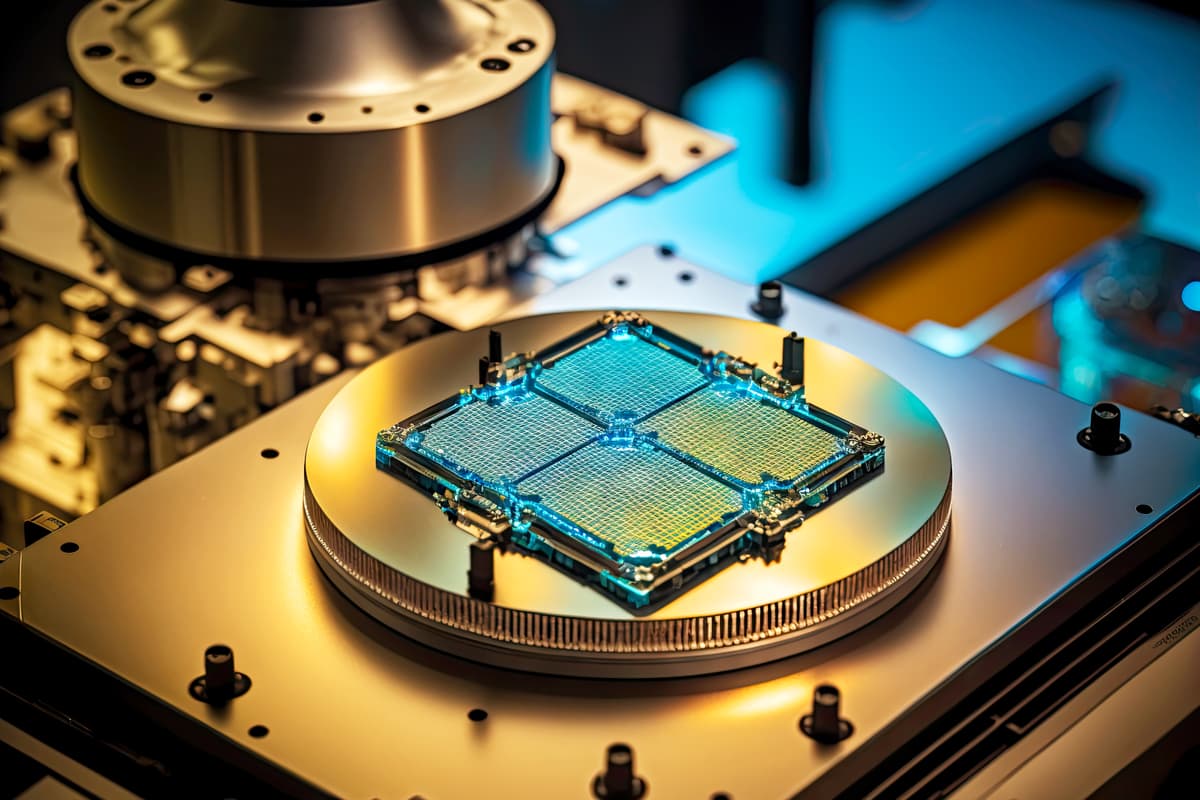
In quantum, manufacturing yield is becoming paramount. “We need processes where 95%+ of qubits on a wafer meet baseline specs. Right now, variability is the enemy.” This requires moving from manual tuning to automated calibration and adopting semiconductor tools like statistical process control.
The goal is to turn qubit fabrication from a craft into a disciplined engineering practice with predictable outcomes. This moves the industry toward a standard quantum Process Design Kit (PDK), a concept supported by roadmaps from the Semiconductor Research Corporation (SRC).
Integration and Modularity
No single refrigerator will hold a million qubits. The future is modular. “We’re designing systems where smaller modules of a few hundred qubits are optimized, then linked via high-fidelity quantum interconnects,” Dr. Sharma explains.
This shifts the design philosophy. “Think of a quantum data center with specialized modules for memory, processing, and communication.” This modular approach, advocated by researchers at Microsoft, allows for mixing qubit types optimized for specific tasks.
A Day in the Life: The Reality of Quantum Hardware Development
What does this cutting-edge work actually look like daily? Dr. Sharma’s description demystifies the glamour. “It’s a mix of extreme patience, deep data analysis, and occasional breakthroughs buried in weeks of debugging.”
Debugging at Millikelvin
“The most surreal part is debugging,” she laughs. “Your system takes days to cool. You see weird results, have a hypothesis, but must warm it up over days, make a microscopic change, and cool it again. One cycle can take two weeks. It teaches meticulousness.”
This slow cycle places a premium on simulation and indirect diagnostics. Teams use tools like Qiskit Metal to predict outcomes before committing to a lengthy experimental run.
Interdisciplinary Collaboration
“No one is just a ‘quantum engineer,'” Dr. Sharma emphasizes. “My team includes physicists, electrical engineers, materials scientists, and software engineers. A typical meeting might involve debating quantum mechanics, the thermal conductivity of a new alloy, and a Python API—all before lunch.”
This collaborative environment is the most exciting and essential aspect of the work. It bridges deep scientific theory with practical engineering execution.
The Road Ahead: Realistic Timelines and Future Breakthroughs
Given the challenges, what is a realistic outlook? Dr. Sharma is optimistic but grounded. “We will see steady, incremental progress. The next five to ten years are about demonstrating clear utility—quantum advantage—for specific, valuable problems.”
Key Milestones to Watch
She identifies tangible engineering milestones:
- A single fault-tolerant logical qubit with error rates below the threshold for scalable error correction.
- Major improvements in qubit connectivity within a module, moving beyond nearest-neighbor coupling.
- A high-fidelity quantum link between two separate processor modules, proving modular scaling.
Each benchmark unlocks new algorithmic possibilities and brings us closer to solving real-world problems beyond classical supercomputers.
The Role of Classical Computing
Quantum computing will not replace classical computing; it will be deeply integrated. “The most powerful system will be a hybrid quantum-classical compute cluster,” Dr. Sharma predicts.
“The quantum processor will be a specialized accelerator. The majority of the work—data prep, error correction, optimization—will be done by powerful classical computers sitting right next to it.” This symbiosis means advances in classical computing, particularly in high-performance control and simulation software, will directly accelerate the quantum timeline, making co-development essential.
FAQs
The biggest misconception is that building a quantum computer is primarily a physics problem. While the science is foundational, the overwhelming challenge today is engineering. It’s about materials purity, manufacturing yield, heat management, control system latency, and software integration. We are in an era of extreme engineering.
Simply adding more physical qubits doesn’t directly translate to more computational power if those qubits are noisy and error-prone. The key metric is the number of reliable logical qubits, which require many error-prone physical qubits to create through quantum error correction. Scaling requires improving qubit quality (coherence and gate fidelity) in tandem with increasing quantity to make this overhead manageable.
“Failure” in this context isn’t like a bulb burning out. Qubits don’t typically have a finite lifespan in that sense. The challenge is maintaining their quantum state (coherence) long enough to perform useful calculations, which is currently on the order of microseconds to milliseconds. The hardware itself, if kept in its ultra-cold, protected environment, can remain physically stable for extended periods, but the quantum information it holds is extremely fragile and short-lived.
It is increasingly unlikely that one modality will “win” for all applications. The future is likely heterogeneous. Superconducting qubits may power centralized processing units, trapped ions may excel as quantum memory or network nodes, and photonics may form the “internet” connecting them. Different problems will benefit from different qubit properties, leading to specialized hardware, much like classical computing today.
Conclusion
The journey to a practical quantum computer is a marathon of meticulous engineering. As Dr. Anya Sharma’s insights reveal, today’s qubit designs are remarkable achievements sitting at the intersection of extreme technologies.
The path forward is paved with challenges in materials, control, and systems integration, demanding unprecedented collaboration. The promise of quantum computing is being forged in cleanrooms by teams solving hard problems one wiring diagram and one coherence measurement at a time.
For observers, look beyond qubit count headlines. Focus on the engineering milestones: improved coherence, higher fidelities, modular scaling, and standardized fabrication. The future of computing is being built today through precision engineering as much as through quantum mechanics.